
|

» To learn more about the Phil Zwickler Memorial Research Grants at Cornell, please click here.
Since 2002, the foundation has supported Phil Zwickler Memorial Research Fellow Grants
at Cornell University. These grants have offered select scholars financial
assistance for expenses incurred when they conduct research on sexuality with
sources in the Division of Rare and Manuscript Collections at the Cornell University
Library. The Phil Zwickler
Memorial Research Fellow Grants, made possible through the generosity of the Phil Zwickler
Charitable and Memorial Foundation Trust, have assisted numerous exciting projects.
Applications are due annually by March 31.
During the past 14 years, we have had 3 repeat winners, including Christina B. Hanhardt (2003, 2010),
Tim Retzloff (2005, 2010) and David Johnson (2006, 2011). We urge all of our fellows to apply again.
In 2013, Jeff Silver and his family, fund matched our long standing yearly fellowship grant at Cornell University.
His daughter, Kailee, attends Cornell and had an opportunity to meet with Brenda Marston. We are excited about the
match which allowed Brenda to fund five new fellows for the current year.
|
|
Recently Published:
Out of the Closet, Into the Archives: Researching Sexual Histories
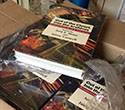
Two of our Cornell scholars, Amy L. Stone and Jaime Cantrell, recently published their book, Out of the Closet, Into the Archives: Researching Sexual Histories.
To read the abstract, please click here, or to purchase the book, please click here.
|

|
|
Another Success Story:
A 2002 winner, Leisa D. Meyer (see 'Sex in the Stacks' poster below), updates us on her activities and refers a student, Helis Sikk, who was awarded a 2014 Zwickler fellowship.
Click on the image to the left to read an edited note from Leisa.
|
|
|
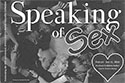
Speaking of Sex
Cornell University Library celebrated the 25th anniversary of the Human Sexuality Collection
with an exhibition entitled "Speaking of Sex" from Feb 14-Oct 11, 2014.
|
|
|
|
Brenda Marston Interview
As part of our 20 year anniversary tribute to Phil, Brenda Marston participated in a video interview.
To watch the video, click on the image to the left.
|
|
|
Read press releases from Cornell University:
|

|
|
In a press release dated May 16, 2011, Cornell University celebrates the 10th year of the program
with three new grants. To read the release, please click here.
|
|

|
|
In a press release dated May 18, 2010, Cornell University proudly discusses the success of the
Phil Zwickler Memorial Research Grant program. To read the release, please click here.
|
|

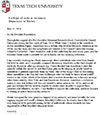
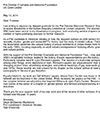
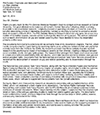
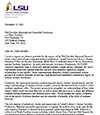
Please click on the images to read letters written by the Cornell Fellows, each of whom
were recipients of a Zwickler Charitable and Memorial Foundation Trust Grant.
To illustrate our collaborative model, our two 2007 fellow letters come from Stefanie Snider, who was referred by Richard Meyer ('03), and Scott Morgensen, our first repeat winner.
In addition, we highlight Brenda Marston's vetting process of one of our 2009 award winners, Lauren J. Gutterman:
-
Lauren made an exploratory trip here last summer, and wants to come back for more serious research.
She wrote: "Because married women were so secretive about their same-sex relationships it is very
difficult for historians to learn about them; this is why the HSC's Valerie Taylor Collection and
Valerie Taylor Papers are so crucial to my dissertation on lesbian wives and the discourse around them."
For her dissertation, her research here will be complemented by research on two other major authors
of lesbian novels during the Cold War era and on an overlooked expression of panic from moral and
medical authorities about lesbian wives in the period. Her advisor wrote in the letter of reference
"She is the kind of responsible scholar who sees her tasks not only as passing hurdles, gaining
qualifications and getting a job, but also as adding to historical understanding in a way that will
make a difference." In addition, she wrote that "Like so many graduate students in New York City,
her fellowship stipend is not even enough to support her basic living expenses, let alone research travel.
Click on the images to read letters from Cornell Fellows:
Desirae Embree
|
Farah Art Griffin
|
Chris Babits
|
Javier Fernandez
Galeano
|
Stephen Vider
|
Dr. Emily Skidmore
|
|
|
Devin McGeehan
Muchmore
|
Marie-Amelie George
|
Jaime Cantrell
|
Amy L. Stone
|
Whitney Strub
|
David B. Green Jr.
|
|
|
Lauren J. Gutterman
|
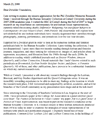
Stefanie Snider
|
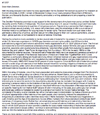
Scott Morgensen
|
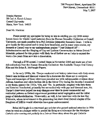
Tim Retzloff
|
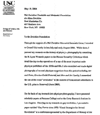
Richard Meyer
|
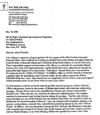
Christina B. Hanhardt
|
|
|
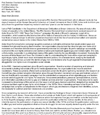
Gill Frank
|
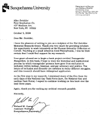
Richard M. Juang
|
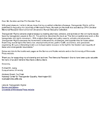
Richard M. Juang
|
|
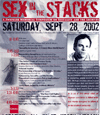
Sex in the Stacks
|
|
In the first year of the Fellowship Grant program at Cornell, the grants were
awarded during a two day seminar in September 2002. Please click
on the image to see the imaginative poster that was designed for the seminar.
|
|

» To visit the Human Sexuality Collection at Cornell, please click here.
|
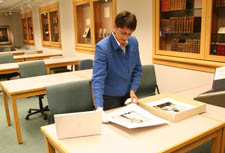
Brenda Marston
Director of the Human Sexuality Collection at Cornell University (Photo: Kenneth Williams)
|
|
An Introduction by Brenda Marston
Phil Zwickler's archives are housed in Cornell University Library's Human Sexuality Collection,
which celebrated its 25 year anniversary in 2014.
Brenda Marston heads this program and has built a wonderful research
facility for scholars of sexuality.
As curator of Cornell University's Human Sexuality Collection, Marston has, in the words
of a former University of Wisconsin-Madison professor, "created space in the public sphere for a series of historical
voices that were heretofore suppressed by a largely homophobic culture. Without the kind of
resources Brenda has collected and profiled, these voices would not be heard, and thus,
to a larger society, they would not even appear to exist. Brenda has, in effect, created
a large part of the historical record that contemporaries and historians will have to
study to understand the present."
|
|
Part of the genius of this collection is that it brings together so many varied and
relevant collections, allowing researchers in Cornell's reading room to gain perspective
on national trends in sexual politics and gay culture over the course of the 19th, 20th,
and 21st centuries. Valuable records of Latinos, African-Americans, and other people of
color strengthen the Collection, and its depth is further augmented by international
periodicals and by the holdings of Cornell's Rare Book collection.
Brenda is always eager to hear from people with new collecting ideas. She attends
the national Creating Change
conference sponsored by the National Gay and Lesbian Task Force to be able to talk with
activists about their issues and ideas. A few categories of material she is currently
seeking include:
- papers of long-time HIV/AIDS survivors (letters, diaries, photo albums, notes reflecting the experience of people who have been living with HIV/AIDS for a long time now),
- papers of Intersex and transgender activists,
- records of national bisexual rights organizations,
- documents from same-sex couples' marriages around the country (photographs, copies of whatever legal forms were signed, wedding announcements, congratulations cards, rejection letters for marriage applications, etc.), as well as records of marriage equality activism,
- the tapes and transcripts from oral history projects, especially those documenting issues of race and sexual/gender identity, and
- the papers and libraries of long-time gay and lesbian activists.
|
|








